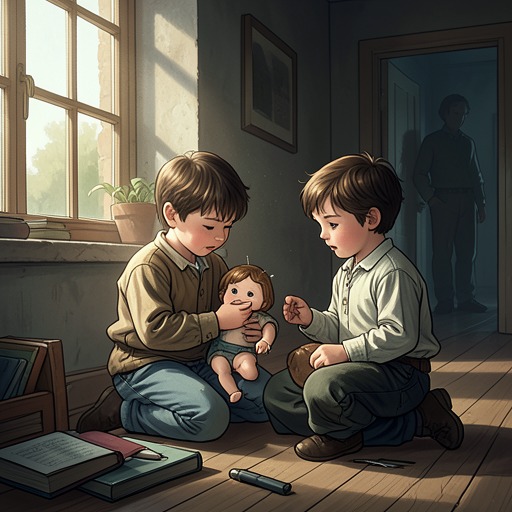
Nina Takes Back Elena’s Doll and Breaks with the Narrator
The Lost DaughterNina Takes Back Elena’s Doll and Breaks with the Narrator is the confrontation in which Leda’s private concealment becomes visible to Nina. When Leda brings Elena’s Doll (Nani) into a conversation that had seemed to concern the apartment keys, Nina recognizes the doll and understands that Leda kept it while Elena cried and Nina struggled to cope. Nina reclaims it and refuses any further relationship with Leda. The doll is not merely recovered property: its return exposes the distance between Leda’s knowledge and her failure to act, making an unspoken grievance suddenly direct and irreversible.
The Objects Before the Revelation
The encounter begins with an exchange of objects and favors. Nina has told Leda, “I can’t take it anymore.” Leda searches for her gaze, agrees, and sets the keys on the table beside the hat and the pin. The offer appears to answer Nina’s immediate need, but the objects acquire a different weight once the doll appears. The keys promise access to Leda’s apartment; the hat and pin recall an earlier moment when Leda helped Nina secure her hat against the wind. At that time, Leda fixed it in Nina’s hair with the long pin with the amber handle, then warned her to disinfect it because it could scratch Elena. Nina had wanted to pay for the pin, and Leda had objected. The scene of help had already joined care to an object that could also cause harm.
The book gives other small exchanges a similarly mixed charge. On arriving at her rented penthouse, Leda found a carefully arranged tray of fruit left by Giovanni, the caretaker; much of it was overripe or rotten, and she threw almost all of it away. On the beach, after Nina’s family had celebrated for hours, Nina approached Leda with a slice of raspberry-colored ice and explained that it was her birthday. Leda accepted it despite not wanting it. These moments do not explain the confrontation, but they place it within a world where gifts and offers do not guarantee intimacy. The keys, hat, pin, and doll likewise carry meanings beyond their use, and the two women do not assign them the same meaning.
Recognition and Accusation
Leda rises as if to give Nina something else. She goes to the bedroom, takes Nani, and returns to find Nina playing with the keys, a half-smile on her lips. Nina looks up; the smile disappears. Her recognition is immediate: “You took her.” The doll’s presence changes the scene from an apparent negotiation over the apartment into a reckoning over what Leda did and withheld. Nina jumps up, leaving the keys on the table as if they burn her, and asks why. Leda answers that she does not know.
Nina’s disbelief sharpens into anger. She points to the contradiction between Leda’s work as someone who reads and writes all day and her professed inability to explain herself. Then she names the injury: Leda had the doll and kept it without telling her, while Nina’s daughter was crying and driving her mad. Leda saw them, Nina says, but did not speak or intervene. The accusation is specific: Nina is not simply angry that the doll went missing, but that Leda privately possessed the object while leaving Nina alone with Elena’s distress. The doll makes the hidden interval tangible. What had been invisible to Nina is now in Leda’s hands.
The confrontation also echoes an earlier account Leda gives Rosaria. When Rosaria notices the injury on Leda’s back, Leda explains that her own daughter got lost on a Sunday in August almost twenty years earlier and that anguish had blinded her; in that situation, she says, strangers are more useful. Rosaria responds that it was fortunate Leda had been there. The earlier recollection recognizes how urgently a child’s distress may call for help from someone outside the family. Nina’s later charge reverses that expectation: Leda was present, saw the mother and child, and still did nothing. The juxtaposition makes her failure more pointed without resolving its motive.
Repossession and Rupture
Leda calls herself an unnatural mother. Nina agrees emphatically. She takes the doll from Leda’s hands in a fierce gesture of repossession, then says in dialect that she has to go and tells Leda in Italian that she never wants to see her again or accept anything from her. Her rejection reaches beyond the doll: it refuses the relationship and the exchange of favors that had just seemed possible. Nina moves toward the door.
Leda tells her to take the keys. She says she is leaving that night and that the house will be empty until the end of the month, then turns toward the window because she cannot bear to see Nina so maddened with rage. She murmurs an apology. The offer of the apartment remains beside the pin and hat, but it cannot repair what the doll has revealed. Nina’s response has changed the value of the keys: what appeared to be practical help now stands within a scene of accusation and severance, and the text does not show the offer undoing either.
Narrative Significance
The scene’s turn depends on a delayed disclosure. Nina first sees the keys and appears to be playing with them; the smile vanishes only when Leda returns carrying Nani. The sequence makes recognition, rather than an explanation from Leda, the trigger for the confrontation. Leda’s silence leaves Nina to state what the doll means: proof that Leda kept it while Nina and Elena were in distress. Her answer, that she does not know why, offers no account capable of displacing that evidence.
The doll also reverses the apparent direction of care. Leda had brought it forward as something additional to give, but Nina experiences it as something taken from her and kept without her knowledge. Her fierce retrieval restores possession while exposing the unequal knowledge between the women. The scene ends not with reconciliation but with Nina going toward the door and Leda turning away, apologizing as she tells her the apartment will be empty. The keys can still be offered; trust, once the concealed doll is recognized, cannot be restored by the offer.